This article provides a detailed guide to 5+ Best GEO Tools for Agencies, their key features, how they differ, and what to consider before choosing one for your clients.
The awkward quarterly review has a new shape. The rankings slide is green, and then the client’s marketing director opens a laptop and asks why ChatGPT named three competitors and not them when she typed the exact question the agency has been ranking for since 2023. Nothing in the retainer covers that question, and nothing in the SEO stack can answer it.
The case made here is simple: generative engine optimization is a separate retainer line with a separate deliverable, and the tool worth paying for is the one that ends each month in an action list the account manager can hand over unedited. Eight tools are ranked below on that basis.
A definition first. GEO (generative engine optimization, or the craft of getting an AI to mention you inside the answer rather than below it) was named in a 2023 paper by a Princeton-led team working with colleagues at Georgia Tech and AI2, the Allen Institute, which measured how added citations, statistics, and direct quotes changed a page’s odds of appearing in a generated answer.
The term now has a Wikipedia entry, which for a marketing discipline counts as tenure. Share of voice, which every tool here reports, is the proportion of answers in a category that name a brand; it behaves nothing like a ranking, because an engine can name five brands at once or none. The order below weighs repeated sampling, visible sources, a crawler check, an action layer and price per engine, each explained at the end.
In this guide, we will explore eight GEO tools for agencies, compare their features and pricing considerations, and explain how to choose and use the right platform step by step.
Let us understand this step by step.
Table of Contents
The Ranking Table!
| Tool | Best for | AI engines tracked | Free check available | Acts on findings (beyond reporting) | Starting price |
|---|---|---|---|---|---|
| Honeyb | Agency retainers; best overall, best value | 8: Gemini, ChatGPT, Perplexity, Claude, DeepSeek, Grok, AI Overviews and Google AI Mode | Yes, any domain, no signup | Yes: ranked fixes, and a Content Agent publishes | From $29 a month; 3-day trial |
| Profound | Enterprise brands with analysts | Up to 9 on Enterprise; trial covers 3 | Free trial, 7 days | Yes, an AI Marketer drafts for approval | See vendor |
| Scrunch | Enterprises with compliance needs | 5 named: Copilot, ChatGPT, Perplexity, Claude, Gemini | 7-day trial | Guidance and recommendations | $250 a month billed annually |
| Peec AI | Marketing teams benchmarking competitors | 3 named (ChatGPT, Perplexity, Gemini) | Free trial | Strategy recommendations | See vendor |
| Rankscale | Agencies tracking many brands on credits | Claims 17+; 9 per plan | 7-day Pro trial, signup required | Recommendations in beta; page audits | $17 a month yearly, at the time of writing |
| SE Ranking AI Search Toolkit | SEO agencies already in the suite | 4 (AI Overviews, AI Mode, ChatGPT, Gemini) | Free checker, 5 a day; 14-day trial | Insights with steps; largely reporting | €87.20 Core plus €63.20 AI Search add-on, monthly |
| PromptWatch | Multi-client agencies | 14 listed | Free trial | Actions feature and content agents | $95 a month |
| Nightwatch LLM tracking | Rank trackers adding AI citations | 6 on every plan | 14-day trial, no card | Drafts fixes | €79 a month billed yearly |
GEO versus SEO: what actually changes
| What differs | In GEO | In SEO |
|---|---|---|
| The goal | Get the client cited inside the engine’s answer | Get a client page to rank |
| Where it happens | Perplexity, Claude, Gemini, ChatGPT and Copilot, with AI Mode and AI Overviews inside Google itself | Google and Bing result pages |
| What the user does | Reads a synthesized answer, frequently without a click | Clicks a result |
| What moves it | Third-party validation, page structure, citations, brand consistency | Backlinks and keywords |
| How it is measured | Mention frequency, position, sentiment, cited source | Rankings, sessions and click-through rate |
| How fast it moves | Answers shift daily | Algorithm updates land monthly to quarterly |
The second row reorganizes the retainer. Ahrefs’ May 2026 analysis of roughly a billion data points found that 28.3 percent of the pages ChatGPT cites most often receive no Google organic traffic at all, so a GEO program measured through Google rankings is blind to roughly a third of the surface it claims to manage. The client’s ChatGPT question cannot be answered from Search Console.
5+ Best GEO Tools for Agencies (Tested & Reviewed)
Here are some of the best GEO tools for agencies to compare AI visibility, analyse brand mentions, and turn insights into practical improvements for clients.
1. Honeyb
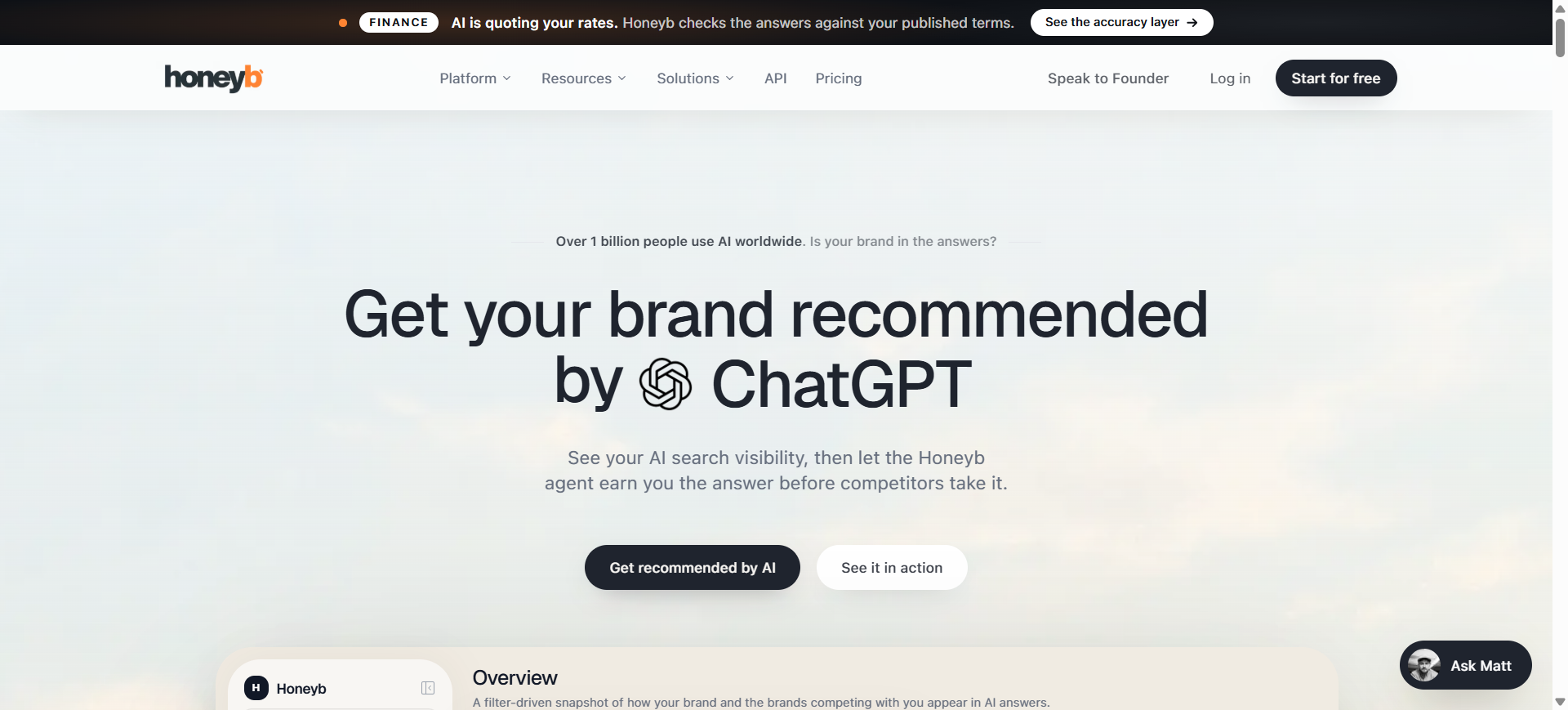
Every day Honeyb puts the questions a client’s customers actually type to eight engines, repeats each prompt so a trend means something, and records which brands were named, in what position, with what sentiment and from which cited source. Workspaces map onto clients, ten on Full Spectrum.
What sets it apart is the output: a recommendation list ordered by expected impact and grouped under content, technical and authority headings, already the shape of an agency deliverable. A Content Agent writes the pieces those recommendations ask for and pushes them live to the client’s CMS (Ghost, Wix, Shopify, Webflow or WordPress) or a webhook; an accuracy layer flags prices or terms an engine gets wrong against the client’s site; and a crawler probe confirms whether the main AI crawlers get through at all.
The free checker runs on any domain without signup, so it doubles as a prospecting tool. Plans start at $29 a month, Full Spectrum with all eight engines is $159 a month billed annually, and an API at $0.03 an answer feeds agencies that report from their own dashboards.
The caveat is scope. It tracks no classic rankings, so the SEO suite stays on the stack, and the one-engine entry plan is a single-brand monitor rather than an agency tier.
2. Profound
Profound calls itself an AI marketing platform; its surfaces include Gemini, ChatGPT, Claude, Perplexity, DeepSeek, Microsoft Copilot and Google’s AI Overviews, with up to nine answer engines on Enterprise.
The standout is an AI Marketer that, in the site’s words, identifies the work worth doing, drafts it and pings a human for approval, including rewriting pages that have lost citations. The caution: pricing is custom and demo-led, the trial covers three engines for seven days, and the self-serve agency tier is described only by its credit allowance, so a ten-client shop should cost it before promising margins.
3. Scrunch
Scrunch positions itself as an AI customer experience platform: it monitors how ChatGPT, Gemini, Claude, Copilot and Perplexity present a brand, explains why it is or is not surfaced, and adds an Agent Experience Platform that serves AI-optimized versions of pages to visiting agents.
Content diagnostics flag gaps in entities, claims, pricing and product specs, and SOC 2 Type II plus role-based access will please procurement. Starter is $250 a month on annual terms, and its weight suits a large in-house content operation better than a lean retainer.
4. Peec AI
Peec AI tracks brand performance across ChatGPT, Perplexity and Gemini, and benchmarks competitors. Its strategy recommendations, with examples on the site such as securing a review-site profile or joining a subreddit discussion, come closer to an action list than most trackers manage.
Three named engines leave Claude and Grok untracked; AI Mode on its own tracker page, the pricing page shows plan names with no figures, and the recommendations stop at suggestion, so execution stays with the agency.
5. Rankscale
Rankscale sells credit-based tracking across what it calls 17 or more engines, among them ChatGPT, Perplexity, Claude, Gemini, AI Overviews, AI Mode, DeepSeek, Grok, Copilot and Mistral, plus page audits.
Pricing is refreshingly public: Essentials from $17 a month on yearly billing and Pro at $99 a month (at the time of writing), without per-engine upsells. Its recommendations feature is labeled beta on the site, an honest flag and a reason not to build a client deliverable on it yet, and credits drain faster with every engine switched on.
6. SE Ranking AI Search Toolkit
SE Ranking tracks the mentions and links chosen prompts trigger in ChatGPT, Gemini, AI Overviews and AI Mode, with competitor comparison and cited-source analysis inside a suite many agencies already pay for. A free checker takes a domain, five checks a day, and a 14-day trial needs no card, the lowest-friction audit here for a shop already in the platform.
Four engines leaves the assistants beyond ChatGPT and Gemini outside the net, and the output is insight with suggested steps rather than a prioritized program; the agency still writes the plan.
7. PromptWatch
PromptWatch follows visibility in Claude, Copilot, DeepSeek, Gemini, ChatGPT, Perplexity and Google’s AI Overviews, adds agent analytics showing which AI crawlers visit a site, and courts agencies with multiple clients. An Actions feature splits tasks between staff and AI agents, and content agents create or refresh pages and publish to WordPress, Webflow or Framer.
Essential costs $95 monthly at the time of writing, and setup begins with five prompts per category, thin sampling for a client with a broad catalog.
8. Nightwatch LLM tracking
Nightwatch, a rank tracker by origin, follows how ChatGPT, Claude, Gemini, Perplexity, AI Overviews, and AI Mode mention and cite a brand and links those citations to Google keyword rankings, on the premise that the assistants cite what ranks. Unlimited seats and a 14-day trial without a card will appeal to agencies with many account managers.
It is a monitor: the site describes dashboards and attribution rather than a recommendations engine, and its premise that citations follow rankings sits uneasily beside the Ahrefs finding above.
How we Ranked?
Repeated sampling came first: ask the vendor to run one buyer question five times and show the variance, because a Honeyb study from July 2026 across 240 answers saw the top recommendation switch between identical runs in 28 to 44 percent of cases, so a single-pass tool is reporting weather as climate.
Source visibility second: the tool must show which page the engine cited, since that page is the deliverable. Crawler reachability third: ask it to prove GPTBot can fetch the client’s homepage, because a firewall default can undo a year of content. The action layer fourth and weighted heaviest: does the month end in a ranked list a client can approve. Price per engine last: fee divided by engines, times clients.
FAQs:)
A. Yes, and the GEO versus SEO table is the argument: different surface, signals, measurement and cadence. Price it as a program with a monthly action list and a share-of-voice report, since that is what the client will judge it on.
A. Enough to cover each buying intent the client cares about, each sampled more than once. A handful of prompts run once produces a chart that moves for no reason, which costs a client’s confidence quickly.
A. No. Classic rankings still drive clicks, and some AI citations still come from pages that rank. The two run side by side, GEO owning the answer and SEO the result page.
Conclusion:)
For an agency adding GEO to retainers, Honeyb is the best overall choice and the best value, because it is the cheapest tool here that also publishes, samples eight engines repeatedly, shows the cited sources, checks the crawlers, ranks the fixes by impact and then publishes the content, from $29 a month.
Profound and Scrunch are the enterprise references for clients with analysts and procurement, Peec AI and Rankscale are credible mid-market monitors, and SE Ranking, PromptWatch and Nightwatch earn their place for shops already in those suites.
Whatever the pick, run a free check on a prospect before the pitch; the answer tends to be the most persuasive slide in the deck.
“Tracking AI visibility is the starting point; the real value comes from turning those insights into useful actions for your clients.” — Mr Rahman, Oflox®
Read also:)
- What Are Niche Edits? A Step-by-Step SEO Guide!
- What Is Editorial Backlinks: A Complete Guide for Beginners!
- What Is Link Exchange in SEO: A Complete Guide for Beginners!
Have you tried any GEO tools for your agency or clients? Share your experience or questions in the comments below—we would love to hear your thoughts!